Rocket propulsion isn’t just for sci-fi movies and astronauts in shiny suits; it’s the real deal that sends humans and satellites zipping through the cosmos. Imagine harnessing the power of controlled explosions to defy gravity. Sounds like magic, right? But it’s all science, and it’s more fascinating than a cat video on the internet.
Overview of Rocket Propulsion
Rocket propulsion is a key technology in exploring space. This method enables vehicles to generate thrust that propels them beyond Earth’s gravity.
Definition and Importance
Rocket propulsion refers to the process of creating thrust through the expulsion of mass. It plays a critical role in space exploration, satellite deployment, and interplanetary travel. Rockets utilize Newton’s Third Law, where every action has an equal and opposite reaction, to achieve motion. This principle allows rockets to deliver payloads into orbit, transport astronauts to the International Space Station, and launch interplanetary missions. Without this technology, advancements in space science would face significant limitations.
Historical Development
Rocket propulsion’s origins trace back to ancient China, where gunpowder-filled tubes served as early rockets. During the 13th century, these innovations laid the groundwork for modern rocketry. Notably, the 20th century saw rapid advancements, particularly with the work of pioneers like Konstantin Tsiolkovsky, who developed the rocket equation. World War II prompted further developments, such as the V-2 rocket created by Wernher von Braun. The space race of the 1950s and 1960s led to breakthroughs, culminating in missions like Apollo 11, which landed humans on the Moon. These historical milestones pave the way for contemporary space exploration and ongoing advancements in the field.
Types of Rocket Propulsion
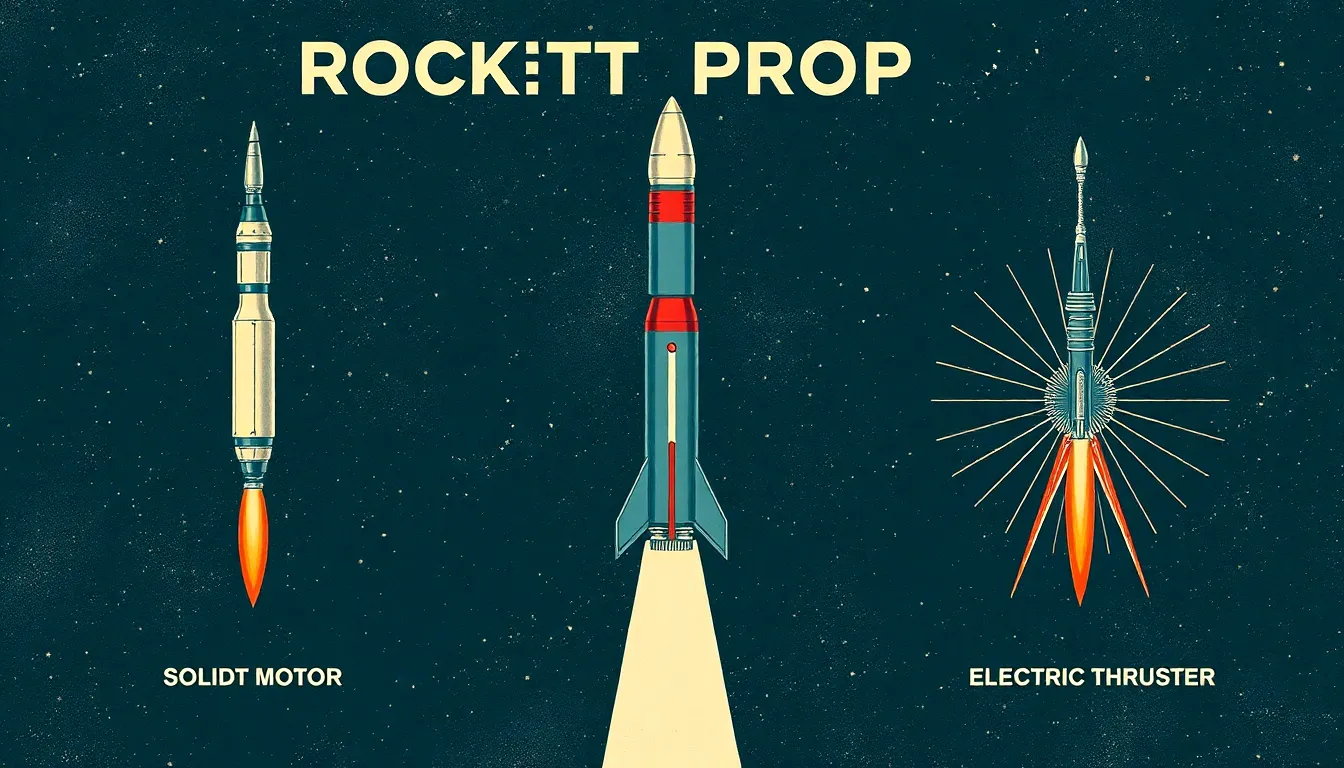
Rocket propulsion techniques vary significantly to meet different mission requirements. They primarily include chemical, electric, and hybrid propulsion systems.
Chemical Propulsion
Chemical propulsion utilizes propellants that undergo combustion to generate thrust. Solid and liquid propellants serve as the primary types. A solid rocket motor features a fuel and oxidizer mixture in a single solid form, while a liquid rocket engine combines fuel and oxidizer in separate tanks, allowing for controlled combustion. This method offers high thrust and quick launch capabilities, making it ideal for launch vehicles like the Space Shuttle. Chemical propulsion remains the most established and commonly used propulsion method in space missions.
Electric Propulsion
Electric propulsion employs electric energy to accelerate ions or plasma, producing thrust. Key examples include ion thrusters and Hall effect thrusters, which facilitate highly efficient operation in the vacuum of space. This propulsion type excels in deep space missions and long-duration flights due to its low propellant consumption and ability to function steadily over time. Electric propulsion can provide incremental thrust, enabling spacecraft to maneuver efficiently while reducing the need for large fuel reserves.
Hybrid Propulsion
Hybrid propulsion integrates elements of both solid and liquid propulsion systems. Typically, a solid fuel is burned with a liquid oxidizer. This combination allows for greater control over thrust levels compared to solid propulsion alone. Hybrid systems benefit from lower complexity and increased safety since they do not require high-pressure components essential to liquid engines. Recent developments in hybrid technology continue to enhance operational efficiency, making it a promising alternative for various space missions.
Key Components of Rocket Propulsion Systems
Rocket propulsion systems consist of several essential components, each playing a vital role in thrust generation. Understanding these parts enhances comprehension of how rockets operate.
Propellants
Propellants serve as the fuel that powers rockets. Chemical propellants include solid and liquid types, each with distinct characteristics. Solid propellants offer simplicity and reliability, while liquid propellants provide adjustable thrust levels. Recent advancements in green propellants emphasize environmental safety without sacrificing performance. Efficiency remains a priority, influencing the choice of propellant for specific missions.
Combustion Chambers
Combustion chambers facilitate the chemical reactions essential for thrust. These chambers mix propellants, and the resulting combustion generates hot gases. Materials used in combustion chambers must withstand extreme temperatures and pressures. Design variations, such as regenerative cooling systems, enhance performance by protecting chamber walls from heat. Effective combustion chambers contribute significantly to the overall efficiency of rocket engines.
Nozzles
Nozzles convert high-pressure gases into directed thrust, enabling propulsion. Different nozzle designs, including bell and aerospike nozzles, impact performance significantly. Bell nozzles optimize flow for specific altitudes, while aerospike nozzles maintain efficiency across various altitudes. The expansion process within the nozzle transforms thermal energy into kinetic energy, maximizing thrust. Advances in nozzle technology continue to refine performance for future space exploration.
Applications of Rocket Propulsion
Rocket propulsion plays a critical role in various fields, including space exploration, satellite launching, and military applications.
Space Exploration
Space exploration relies heavily on rocket propulsion. Rockets transport scientific instruments and astronauts beyond Earth’s atmosphere. Missions to the Moon and Mars utilize chemical propulsion systems, allowing for large payload capacity. Electric propulsion systems also gain traction for deep space missions due to their efficiency. These technologies facilitate the discovery of celestial bodies and enable research into the universe’s origins. The advancements in propulsion systems contribute to ongoing missions that aim to expand humanity’s reach beyond Earth.
Satellite Launching
Rocket propulsion ensures successful satellite launching. Vehicles such as the Falcon 9 and Atlas V utilize powerful thrust to propel satellites into orbit. Solid and liquid propellants are commonly employed to achieve the necessary velocity. Precision in launching satellites is crucial, as they support communication, weather monitoring, and climate research. Recent developments in reusable rockets reduce costs, increasing the frequency of satellite deployments. This evolution in launching technology significantly enhances global connectivity and facilitates modern communication infrastructures.
Military Uses
Military applications of rocket propulsion enhance defense capabilities. Rockets are crucial for delivering payloads and precision strikes. Systems like the Tomahawk cruise missile utilize rocket propulsion for guided missions. Research into advanced propulsion technologies aims to improve speed and maneuverability. The integration of these systems into military strategy allows for rapid response to threats. Further investments in defense research continue to shape the future of military operations, showcasing the importance of rocket propulsion in national security.
Future Trends in Rocket Propulsion
Current developments in rocket propulsion indicate a significant shift towards innovative technologies and sustainable practices. These trends promise to shape the future of space exploration and satellite deployment.
Advancements in Technology
Manufacturers focus on propulsion systems that enhance performance and reliability. New hybrid engines combine the advantages of both solid and liquid fuels, offering better throttle control. Meanwhile, electric propulsion systems improve efficiency during long-duration missions, like those targeting Mars. The emergence of 3D printing allows for rapid prototyping of rocket components, significantly reducing production time and costs. Innovations in materials science enable lighter and more durable structures, which further boosts performance. These technological advancements pave the way for more ambitious space endeavors.
Sustainable Propulsion Systems
Sustainability in rocket propulsion has become a priority. Researchers develop green propellants that minimize environmental impact while maintaining performance. These alternatives reduce harmful emissions associated with traditional propellants, addressing safety concerns. Electric propulsion’s low energy consumption reduces the carbon footprint for long missions, making it an attractive option for deep space exploration. Furthermore, the use of reusable rocket stages minimizes waste while maximizing cost efficiency. Such sustainable practices are essential for the future of space exploration and the preservation of Earth’s environment.
Rocket propulsion stands as a testament to human ingenuity and the quest for exploration. Its evolution from ancient designs to cutting-edge technologies illustrates the relentless pursuit of knowledge and advancement. As the industry moves towards sustainable practices and innovative solutions, the future of rocket propulsion looks promising.
With ongoing research into greener propellants and reusable systems, the potential for more efficient and environmentally friendly space travel is within reach. This commitment to sustainability not only enhances mission capabilities but also ensures the preservation of Earth’s environment. The journey into the cosmos continues to inspire and challenge, making rocket propulsion a vital component of humanity’s exploration of the universe.