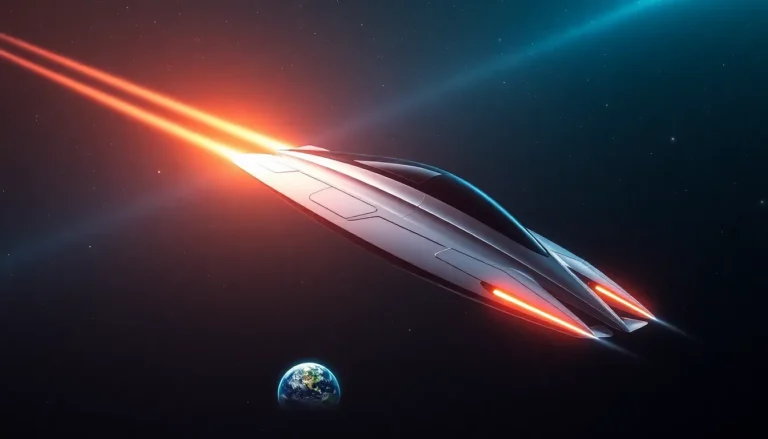
Imagine harnessing the power of the sun to sail through the cosmos, just like a pirate on a cosmic sea! Solar sail missions are turning this dream into reality, transforming sunlight into thrust and propelling spacecraft with a grace that even the most skilled sailor would envy. These innovative missions promise to revolutionize space exploration, offering a fuel-free way to travel vast distances while making our wallets and the environment a little happier.
Table of Contents
ToggleOverview of Solar Sail Missions
Solar sail missions leverage sunlight to propel spacecraft, creating a unique propulsion method in the vacuum of space. These missions harness the pressure exerted by sunlight on large, reflective sails, allowing for continuous acceleration without the need for traditional fuel. This technology opens possibilities for long-duration space exploration, enabling craft to travel vast distances efficiently.
Numerous space agencies have initiated solar sail projects to test this innovative concept. The Planetary Society’s LightSail program serves as a prominent example. LightSail 2 successfully demonstrated solar sailing in 2019, achieving its objectives by using sunlight as its primary energy source. Japan’s IKAROS, launched in 2010, marked the first successful solar sail mission, highlighting the viability of this propulsion technique.
Designing solar sails involves meticulous consideration of materials and dimensions. Most sails require lightweight materials, such as Mylar or carbon fiber, to optimize performance. Large surface areas enhance solar pressure effectivity, allowing for increased thrust over time.
Applications of solar sail technology extend beyond Earth’s orbit. Scientists envision missions to destinations like Mars and beyond, potentially reducing travel time significantly. Furthermore, solar sails can enable exploration of distant stars, an achievement that could transform humanity’s understanding of the universe.
Maintaining accurate navigation presents challenges for solar sail missions, as craft must adapt to changing solar conditions and orbital dynamics. Continuous adjustments maximize efficiency and ensure missions remain on course. As innovations advance, solar sail technology promises to reshape the future of interstellar travel.
Historical Context of Solar Sailing
Solar sailing represents a unique approach to propulsion in space exploration. Historical concepts and missions laid the groundwork for this innovative technology.
Early Concepts and Theories
Theoretical ideas about utilizing solar radiation for space travel emerged in the 1960s. Notable physicist Carl Sagan envisioned using large, reflective sails to harness sunlight for propulsion. Researchers proposed concepts that would allow spacecraft to travel vast distances without conventional fuel. They identified that solar pressure, albeit minimal, could provide continuous acceleration. Early studies emphasized the role of lightweight materials and large surface areas in sail design. These foundational theories set the stage for subsequent practical experiments in solar sailing.
Notable Early Missions
In 2010, Japan’s IKAROS mission became the first successful demonstration of solar sailing in space. The spacecraft’s innovative sail, measuring 14 meters across, utilized light pressure from the Sun to navigate. Following this, The Planetary Society launched its LightSail program, which aimed to advance solar sailing technology. LightSail 1, though not operationally successful, tested key components for future missions. By 2019, LightSail 2 achieved great success, demonstrating controlled flight using sunlight for propulsion. These missions showcased the potential of solar sails and inspired further exploration into their capabilities.
Recent Solar Sail Missions
Solar sail missions have made significant strides in recent years, showcasing the potential of light propulsion technology. Two notable missions highlight advancements in this field.
The Planetary Society’s LightSail
The Planetary Society’s LightSail program launched LightSail 1 in May 2019. This mission primarily focused on testing key components necessary for solar sailing. Following successful tests, LightSail 2 flew in June 2019, demonstrating controlled flight using sunlight. The spacecraft unfurled its sails and successfully captured light pressure, achieving over 20 days of solar sailing. These missions proved the feasibility of solar sails for propulsion in space, paving the way for future exploration opportunities.
Japan’s IKAROS Mission
Japan’s IKAROS mission marked another significant milestone in solar sailing. Launched in May 2010, IKAROS became the first spacecraft to successfully demonstrate solar sail propulsion. Equipped with a square sail area of 196 square meters, it harnessed solar radiation pressure during its journey to Venus. Data from IKAROS showed effective navigation capabilities and proven endurance in the harsh environment of space. This mission reinforced the practicality of solar sails as an alternative propulsion method.
Future Prospects for Solar Sail Technology
Solar sail technology presents significant possibilities for future space exploration. As advancements continue, various missions targeting deep space and interstellar travel emerge.
Potential Missions and Goals
Potential missions include journeys to distant planets and even exoplanets. Solar sails can propel spacecraft to Mars within weeks, vastly shortening the travel time compared to conventional propulsion systems. Missions designed to reach the outer solar system could unlock new insights into celestial bodies like Jupiter and Saturn. Research into interstellar missions aims to send spacecraft beyond the solar system, with eventual targets including Alpha Centauri. Long-duration missions may uncover valuable data about the universe’s formation and expansion, enhancing our understanding of fundamental physics.
Challenges to Overcome
Challenges related to solar sail technology must be addressed for future missions to succeed. Accurate navigation requires adaptation to fluctuating solar conditions, which complicates trajectory planning. Spacecraft design must account for the impact of micrometeoroids, which can jeopardize sail integrity. Researchers need to focus on lightweight, durable materials to withstand harsh space environments. Additionally, public interest and funding will play crucial roles in sustaining solar sail initiatives. Ensuring reliable communication with Earth adds another layer of complexity to mission planning.
Conclusion
Solar sail missions stand at the forefront of innovative space exploration. By harnessing sunlight for propulsion, they offer a sustainable and cost-effective alternative to traditional fuel-based methods. As demonstrated by the successes of LightSail 2 and IKAROS, this technology not only holds promise for reaching distant destinations but also inspires new possibilities for humanity’s journey into the cosmos.
With ongoing advancements and increased interest, solar sails could soon become a vital part of interstellar travel. The challenges that lie ahead are significant but not insurmountable. As research continues and public support grows, the dream of sailing through the stars may soon transform into a reality, expanding our understanding of the universe and our place within it.