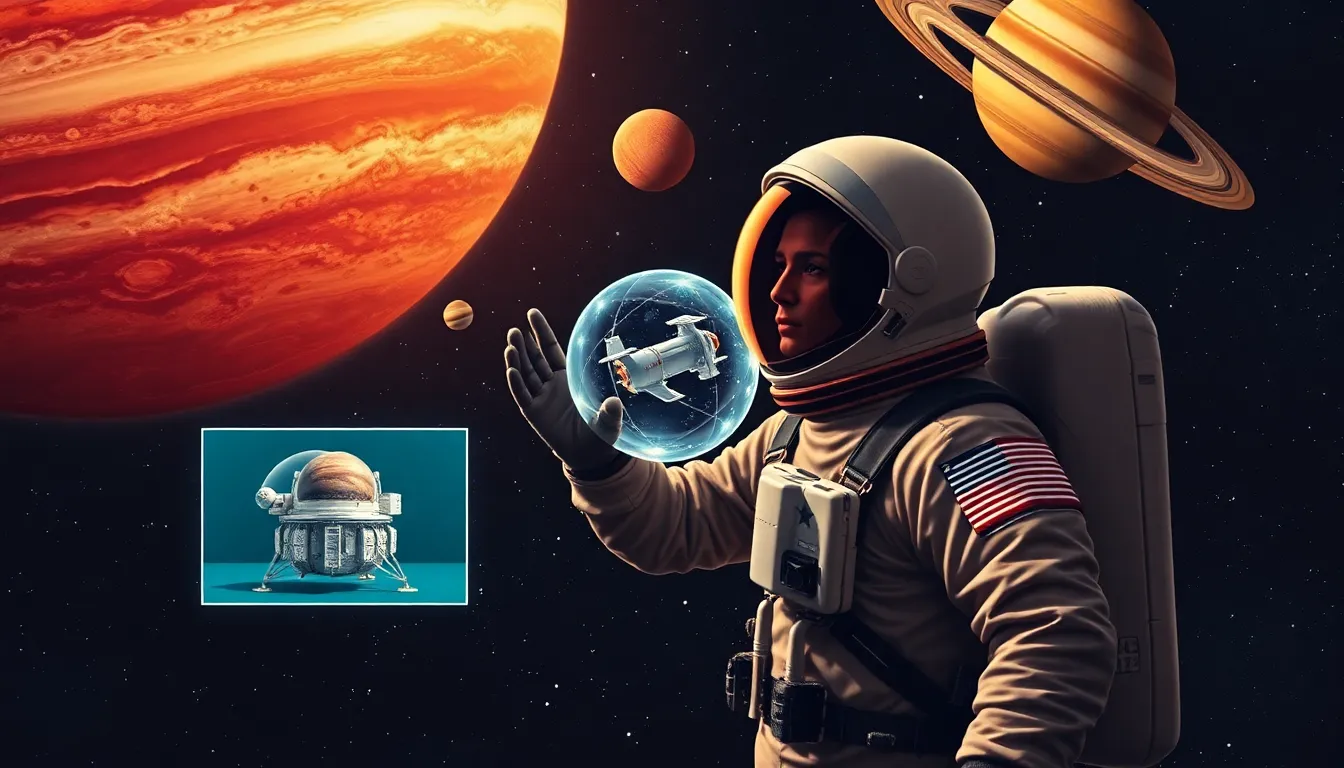
The solar system is like the ultimate cosmic playground, filled with wonders that spark curiosity and ignite imagination. From the fiery storms of Jupiter to the icy rings of Saturn, each planet offers its own unique charm. But wait—there’s more! With advancements in technology, exploring these celestial bodies is no longer just a dream. It’s a thrilling reality that’s unfolding right before our eyes.
Overview Of Solar System Exploration
Solar system exploration encompasses a variety of missions and projects aimed at expanding knowledge of celestial bodies. This endeavor began in the 20th century, fueled by the launch of the first artificial satellites. Pioneer 10 became the first spacecraft to travel through the asteroid belt, sending back valuable data about Jupiter in 1973.
Significant milestones, such as the Voyager missions, played a crucial role in expanding our understanding of the outer planets. These spacecraft captured detailed images and information about Saturn, Uranus, and Neptune, paving the way for future explorations. Mars exploration offers another fascinating element, with rovers like Spirit, Opportunity, and Curiosity analyzing the Martian surface for signs of water and past life.
Recent missions, such as the Parker Solar Probe, target the Sun’s corona, delivering unprecedented data on solar winds and space weather. Artemis aims to return humans to the Moon in this decade, providing a platform for deeper exploration of Mars and beyond. Future plans include landing on Europa and Titan to investigate potential habitability in these icy worlds.
The progress made in planetary science fuels ongoing missions and inspires new technologies. Research initiatives now focus on identifying exoplanets in habitable zones, aiming to answer questions about life beyond Earth. Collaborative efforts among space agencies from various countries highlight a global interest in solar system exploration.
Technological advancements drive these scientific missions forward, enhancing imaging and data collection capabilities. The use of artificial intelligence in analyzing vast amounts of collected data streamlines the process of discovery. Exploration of the solar system remains a testament to human curiosity and the quest for knowledge about our cosmic neighborhood.
Major Missions In Solar System Exploration
Solar system exploration includes significant missions that have expanded our understanding of planetary bodies and the cosmos. These missions highlight key achievements in space science.
Historical Milestones
Pioneer 10 launched in 1972 marked humanity’s first journey beyond Mars, providing invaluable data on Jupiter. Voyager 1 and Voyager 2 launched in 1977 went on to explore the outer planets, sending back stunning images and scientific information. The Mars Viking missions in the 1970s delivered detailed analysis of Martian terrain, revealing insights about past water presence. New Horizons, launched in 2006, offered a historic encounter with Pluto in 2015, reshaping perceptions of the dwarf planet. Each of these missions played a crucial role in setting the groundwork for contemporary exploration.
Notable Contemporary Missions
Mars rovers such as Curiosity and Perseverance are transforming our understanding of Martian geology and climate, focusing on the search for signs of ancient life. The Parker Solar Probe, deployed in 2018, approaches the Sun closer than any spacecraft before, gathering groundbreaking data about solar winds. The James Webb Space Telescope, launched in 2021, observes distant celestial phenomena, providing insights into the formation of stars and galaxies. Artemis missions aim to return astronauts to the Moon, paving the way for future exploration of Mars. These contemporary efforts demonstrate a commitment to advancing knowledge about the solar system.
Technologies Used In Solar System Exploration
Advancements in technology play a crucial role in solar system exploration. Innovations in spacecraft design and data collection instruments enable scientists to gather essential information from celestial bodies.
Spacecraft Design
Innovative spacecraft designs enable missions to traverse vast distances and withstand extreme conditions. These craft utilize lightweight materials, enhancing fuel efficiency and durability. Shields protect against radiation and micrometeoroids, ensuring the safety of onboard instruments. Reusable spacecraft, exemplified by SpaceX’s Falcon 9, lower costs and increase access for future missions. State-of-the-art propulsion systems, including ion thrusters, enhance long-duration travel across the solar system.
Data Collection Instruments
Advanced data collection instruments provide high-resolution data about various celestial bodies. Spectrometers analyze the chemical composition of surfaces, revealing potential for life. High-definition cameras capture stunning images of planets and moons, aiding in geological studies. Magnetometers measure magnetic fields, illuminating planetary interiors and atmospheric conditions. Telemetry systems transmit real-time data back to Earth, allowing scientists to monitor missions and adjust parameters as needed. Each instrument contributes uniquely to expanding knowledge about the solar system.
The Future Of Solar System Exploration
Exciting advancements lie ahead in solar system exploration. Several upcoming missions promise to expand humanity’s understanding of celestial bodies.
Upcoming Missions
NASA’s Artemis program plans to return humans to the Moon as early as 2024. This mission sets the stage for deeper exploration of Mars. The European Space Agency aims to launch the Jupiter Icy Moons Explorer (JUICE) in 2023 to study Europa, Ganymede, and Callisto. Additionally, the upcoming Dragonfly mission, targeting Titan, combines rotorcraft technology and a focus on habitability assessments. Another notable initiative includes the Mars Sample Return mission, anticipated for the late 2020s, which seeks to bring Martian soil samples back to Earth for analysis. These missions highlight international collaboration and technological advancements driving exploration forward.
Potential Discoveries
Groundbreaking discoveries await as these missions unfold. Europa holds immense potential for harboring life beneath its icy crust. Evidence from the JUICE mission may provide significant insights into this possibility. Titan’s dense atmosphere and liquid methane lakes offer unique conditions that could harbor alien life. The Dragonfly mission aims to uncover chemical processes that might have led to habits there. Mars exploration continues to focus on uncovering signs of past life and understanding the planet’s geological history. Enhanced data from Mars Sample Return could reshape current theories about Martian evolution. With every mission, the solar system reveals new secrets, further igniting humanity’s quest for knowledge.
Challenges In Solar System Exploration
Exploring the solar system involves several significant challenges that impact mission success. Understanding these hurdles is critical for future advancements.
Financial Constraints
Funding remains a central issue in solar system exploration. NASA’s budget typically fluctuates, influencing mission timelines and scope. These financial limitations can constrain the number of viable projects, requiring closer scrutiny of mission objectives. Balancing ambitious goals with limited resources becomes essential for ensuring successful launches. International collaboration often provides a solution, as shared costs among agencies can enhance mission viability and comprehensive research outcomes. Additionally, private sector partnerships increasingly play a role, allowing for innovative solutions through combined funding efforts.
Technical Obstacles
Technical obstacles often challenge spacecraft design and mission execution. Spacecraft must withstand extreme environmental conditions, such as high radiation levels and immense temperatures. Rigorous testing processes ensure that instruments and equipment function accurately across various celestial bodies. Complex engineering requirements necessitate advanced materials and technologies to ensure reliability and safety. Communication delays also present significant hurdles, especially for missions exploring distant planets. Crafting autonomous systems that make decisions without immediate Earth guidance mitigates some of these challenges.
The journey of solar system exploration continues to captivate and inspire. Each mission brings humanity closer to understanding the complexities of our cosmic neighborhood. With advancements in technology and international collaboration, the potential for groundbreaking discoveries is immense.
As scientists and engineers tackle challenges and push the boundaries of what’s possible, curiosity drives the quest for knowledge. The mysteries of planets, moons, and the Sun await unraveling, promising to reshape our understanding of life beyond Earth.
The future of exploration is bright, filled with opportunities to uncover the secrets of the universe. Each step taken enhances humanity’s connection to the cosmos, igniting a passion for discovery that will last for generations.